第11章: TinyPython — マイコンで動くPythonを作る#
マイコンの上で動く小さな Python 処理系を作ります。
サンプルコード#
ディレクトリ:
docs/os-on-arduino/code/11_tiny_pythonビルドと書き込み:
uv run pio run -d 11_tiny_python -t upload
uv run pio device monitor -b 115200
ソースコード#
この章のスケッチです。ファイル名をクリックすると開きます。コードは原稿リポジトリから自動で同期されているので、ここに出ているものが常に最新です。
src/main.cpp — 262 行
  1/**
  2 * Chapter 11: TinyPython - A Minimal Python Interpreter
  3 *
  4 * A Python subset interpreter running on Arduino Uno R4 WiFi.
  5 * Supports: variables, expressions, if/elif/else, while, for,
  6 * def functions, print(), and Arduino GPIO control.
  7 *
  8 * This demonstrates how MicroPython works at a fundamental level.
  9 */
 10
 11#include <Arduino.h>
 12#include "Arduino_LED_Matrix.h"
 13#include "tp_config.h"
 14#include "tp_value.h"
 15#include "tp_env.h"
 16#include "tp_eval.h"
 17#include "tp_module.h"
 18#include <string.h>
 19
 20// LED Matrix globals
 21ArduinoLEDMatrix g_matrix;
 22uint8_t g_matrix_frame[8][12] = {0};
 23
 24// Wrapper for renderBitmap (calling via extern doesn't work reliably for C++ objects)
 25extern "C" void matrix_render(void)
 26{
 27    g_matrix.renderBitmap(g_matrix_frame, 8, 12);
 28}
 29
 30// ---- REPL State ----
 31static char g_line_buf[TP_LINE_LEN];
 32static int g_line_pos = 0;
 33static char g_last_char = 0;  // for \r\n handling
 34
 35// Block accumulation mode (for if/while/for/def)
 36static int g_in_block = 0;
 37static int g_block_start = -1;
 38static int g_block_line_count = 0;
 39static int g_block_indent = 0;
 40static char g_block_type[8]; // "if", "while", "for", "def"
 41
 42// For def: store function metadata
 43static char g_def_name[16];
 44static char g_def_params[TP_MAX_PARAMS][16];
 45static int g_def_param_count = 0;
 46
 47static void show_banner(void)
 48{
 49    Serial.println();
 50    Serial.println("  _____  _             ____        _   _");
 51    Serial.println(" |_   _|(_)_ __  _   _|  _ \\ _   _| |_| |__   ___  _ __");
 52    Serial.println("   | |  | | '_ \\| | | | |_) | | | | __| '_ \\ / _ \\| '_ \\");
 53    Serial.println("   | |  | | | | | |_| |  __/| |_| | |_| | | | (_) | | | |");
 54    Serial.println("   |_|  |_|_| |_|\\__, |_|    \\__, |\\__|_| |_|\\___/|_| |_|");
 55    Serial.println("                  |___/       |___/");
 56    Serial.println();
 57    Serial.println("  TinyPython 0.1 on Arduino UNO R4 WiFi");
 58    Serial.print("  SRAM: 32KB, Flash: 256KB");
 59    Serial.println();
 60    Serial.println("  Type Python code. Try: print(1 + 2)");
 61    Serial.println();
 62    Serial.println("  Built-ins:");
 63    Serial.println("    Python:  print, type, len, abs, min, max, int, str, range");
 64    Serial.println("    GPIO:    pin_mode, digital_write, digital_read, analog_read");
 65    Serial.println("    Timing:  delay, millis");
 66    Serial.println("    LED:     led.blink, led.on, led.off");
 67    Serial.println("    Matrix:  matrix.pixel, matrix.show, matrix.clear,");
 68    Serial.println("             matrix.fill, matrix.row");
 69    Serial.println();
 70}
 71
 72static void prompt(void)
 73{
 74    if (g_in_block) {
 75        Serial.print("... ");
 76    } else {
 77        Serial.print(">>> ");
 78    }
 79}
 80
 81// Parse def header: "def name(a, b, c):"
 82static void parse_def_header(const char *line)
 83{
 84    // Skip "def "
 85    line += 4;
 86    while (*line == ' ') line++;
 87
 88    // Read function name
 89    int i = 0;
 90    while (*line && *line != '(' && *line != ' ' && i < 15) {
 91        g_def_name[i++] = *line++;
 92    }
 93    g_def_name[i] = '\0';
 94
 95    // Read parameters
 96    g_def_param_count = 0;
 97    if (*line == '(') {
 98        line++;
 99        while (*line && *line != ')') {
100            while (*line == ' ' || *line == ',') line++;
101            if (*line == ')') break;
102            int j = 0;
103            while (*line && *line != ',' && *line != ')' && *line != ' ' && j < 15) {
104                g_def_params[g_def_param_count][j++] = *line++;
105            }
106            g_def_params[g_def_param_count][j] = '\0';
107            g_def_param_count++;
108            if (g_def_param_count >= TP_MAX_PARAMS) break;
109        }
110    }
111}
112
113static void process_line(const char *line)
114{
115    // Count indentation
116    int indent = 0;
117    while (line[indent] == ' ') indent++;
118    const char *trimmed = line + indent;
119
120    // If we're in block accumulation mode
121    if (g_in_block) {
122        // Empty line or line with less/equal indent than block start = end of block
123        if (trimmed[0] == '\0') {
124            // End of block - execute it
125            if (strcmp(g_block_type, "def") == 0) {
126                // Register function
127                TpFunc *fn = tp_func_new(g_def_name);
128                if (fn) {
129                    fn->body_start = g_block_start;
130                    fn->body_count = g_block_line_count;
131                    fn->param_count = g_def_param_count;
132                    for (int i = 0; i < g_def_param_count; i++) {
133                        strncpy(fn->params[i], g_def_params[i], 15);
134                        fn->params[i][15] = '\0';
135                    }
136                }
137            } else {
138                // Execute block (if/while/for)
139                tp_clear_error();
140                tp_eval_lines(g_block_start, g_block_line_count, 0);
141            }
142            g_in_block = 0;
143            return;
144        }
145        // Accumulate line into block buffer
146        tp_block_store_line(line);
147        g_block_line_count++;
148        return;
149    }
150
151    // Skip empty lines
152    if (trimmed[0] == '\0') return;
153
154    // Check for block-starting keywords
155    // if ...:   while ...:   for ...:   def ...:
156    int is_block = 0;
157    if (strncmp(trimmed, "if ", 3) == 0 && strchr(trimmed, ':'))
158        { is_block = 1; strncpy(g_block_type, "if", 3); }
159    else if (strncmp(trimmed, "while ", 6) == 0 && strchr(trimmed, ':'))
160        { is_block = 1; strncpy(g_block_type, "while", 6); }
161    else if (strncmp(trimmed, "for ", 4) == 0 && strchr(trimmed, ':'))
162        { is_block = 1; strncpy(g_block_type, "for", 4); }
163    else if (strncmp(trimmed, "def ", 4) == 0 && strchr(trimmed, ':'))
164        { is_block = 1; strncpy(g_block_type, "def", 4); }
165
166    if (is_block) {
167        if (strcmp(g_block_type, "def") == 0) {
168            parse_def_header(trimmed);
169        }
170        g_in_block = 1;
171        g_block_start = tp_block_store_line(line);
172        g_block_line_count = 1;
173        g_block_indent = indent;
174        return;
175    }
176
177    // Single line statement - execute immediately
178    tp_clear_error();
179    TpValue result = tp_eval_line(trimmed);
180
181    // Print result if it's not None and no error (REPL behavior)
182    if (!tp_had_error() && result.type != TP_NONE) {
183        switch (result.type) {
184            case TP_INT:  Serial.println(result.ival); break;
185            case TP_BOOL: Serial.println(result.ival ? "True" : "False"); break;
186            case TP_STR:
187                Serial.print("'");
188                Serial.print(result.sval);
189                Serial.println("'");
190                break;
191            default: break;
192        }
193    }
194}
195
196void setup()
197{
198    Serial.begin(115200);
199    while (!Serial) { }
200
201    // Initialize hardware
202    g_matrix.begin();
203
204    // Initialize TinyPython
205    tp_env_init();
206    tp_eval_init();
207    tp_module_init();
208
209    // Register modules (like MicroPython's built-in modules)
210    tp_mod_led_register();
211    tp_mod_matrix_register();
212    tp_mod_gpio_register();
213
214    show_banner();
215    prompt();
216}
217
218void loop()
219{
220    while (Serial.available()) {
221        char c = Serial.read();
222
223        if (c == '\r' || c == '\n') {
224            // Skip \n immediately after \r (handle \r\n as single newline)
225            if (c == '\n' && g_last_char == '\r') {
226                g_last_char = c;
227                continue;
228            }
229            g_last_char = c;
230
231            Serial.println();
232            g_line_buf[g_line_pos] = '\0';
233
234            if (g_line_pos > 0 || g_in_block) {
235                process_line(g_line_buf);
236            }
237
238            g_line_pos = 0;
239            prompt();
240        } else if (c == '\b' || c == 127) {
241            g_last_char = c;
242            // Backspace
243            if (g_line_pos > 0) {
244                g_line_pos--;
245                Serial.print("\b \b");
246            }
247        } else if (c == 0x03) {
248            // Ctrl+C: cancel current block
249            if (g_in_block) {
250                g_in_block = 0;
251                Serial.println();
252                Serial.println("KeyboardInterrupt");
253                g_line_pos = 0;
254                prompt();
255            }
256        } else if (g_line_pos < TP_LINE_LEN - 1) {
257            g_last_char = c;
258            g_line_buf[g_line_pos++] = c;
259            Serial.print(c);  // Echo
260        }
261    }
262}
include/tp_config.h — 43 行
 1/**
 2 * tp_config.h - TinyPython Configuration
 3 *
 4 * Memory budget for 32KB SRAM (Cortex-M / 32bit):
 5 *   Scope stack:  8 * 48 * 28 = 10752 bytes   <- 最大
 6 *   Block buffer:     48 * 80 =  3840 bytes
 7 *   String pool:              =  2048 bytes
 8 *   Function table:   16 * 124 = 1984 bytes
 9 *   Line buffer:              =   128 bytes
10 *   Total:                     ~18.2KB
11 *
12 * 本書 11.14 節の表と対応している。値を変えたら向こうも直すこと。
13 */
14
15#ifndef TP_CONFIG_H
16#define TP_CONFIG_H
17
18// Maximum values in the pool (int, string, bool, none, function)
19#define TP_MAX_VALUES    128
20
21// Maximum variables per scope
22#define TP_MAX_VARS       48
23
24// Maximum scope depth (function calls)
25#define TP_MAX_SCOPES      8
26
27// String pool size
28#define TP_STRING_POOL  2048
29
30// Maximum length of a single input line
31#define TP_LINE_LEN      128
32
33// Maximum lines in a block (if/while/def body)
34#define TP_BLOCK_LINES    48
35#define TP_BLOCK_LINE_LEN 80
36
37// Maximum function parameters
38#define TP_MAX_PARAMS      6
39
40// Maximum nesting depth (for/while/if)
41#define TP_MAX_NEST        8
42
43#endif // TP_CONFIG_H
include/tp_env.h — 60 行
 1/**
 2 * tp_env.h - TinyPython Environment (Variable Storage)
 3 *
 4 * Variables are stored in a hash-map-like structure.
 5 * Each scope (global, function) has its own variable table.
 6 * This is similar to Python's namespace/dict system.
 7 */
 8
 9#ifndef TP_ENV_H
10#define TP_ENV_H
11
12#include "tp_value.h"
13#include "tp_config.h"
14
15#ifdef __cplusplus
16extern "C" {
17#endif
18
19// A variable entry: name -> value
20typedef struct {
21    char name[16];
22    TpValue value;
23    uint8_t used;
24} TpVar;
25
26// A scope (variable namespace)
27typedef struct {
28    TpVar vars[TP_MAX_VARS];
29} TpScope;
30
31// Initialize the environment system
32void tp_env_init(void);
33
34// Push/pop scope (for function calls)
35int tp_env_push_scope(void);
36void tp_env_pop_scope(void);
37
38// Get/set variable in current scope (falls back to global)
39TpValue tp_env_get(const char *name);
40void tp_env_set(const char *name, TpValue value);
41
42// Check if variable exists
43int tp_env_exists(const char *name);
44
45// String pool: intern a string and return a pointer to the pool
46const char *tp_str_intern(const char *s);
47
48// Function storage
49TpFunc *tp_func_new(const char *name);
50TpFunc *tp_func_find(const char *name);
51
52// Block storage (shared buffer for function/loop bodies)
53int tp_block_store_line(const char *line);
54const char *tp_block_get_line(int index);
55
56#ifdef __cplusplus
57}
58#endif
59
60#endif // TP_ENV_H
include/tp_eval.h — 58 行
 1/**
 2 * tp_eval.h - TinyPython Evaluator
 3 *
 4 * Recursive descent parser that evaluates as it parses.
 5 * This is the simplest interpreter architecture:
 6 *   1. Tokenize the input string
 7 *   2. Parse according to grammar rules
 8 *   3. Evaluate immediately during parsing
 9 *
10 * Grammar (simplified):
11 *   statement  = assignment | if_stmt | while_stmt | for_stmt
12 *              | def_stmt | return_stmt | expr_stmt
13 *   assignment = NAME '=' expr
14 *   expr       = or_expr
15 *   or_expr    = and_expr ('or' and_expr)*
16 *   and_expr   = not_expr ('and' not_expr)*
17 *   not_expr   = 'not' not_expr | comparison
18 *   comparison = add_expr (('==' | '!=' | '<' | '>' | '<=' | '>=') add_expr)*
19 *   add_expr   = mul_expr (('+' | '-') mul_expr)*
20 *   mul_expr   = unary (('+' | '-' | '%') unary)*
21 *   unary      = '-' unary | atom
22 *   atom       = INT | STRING | 'True' | 'False' | 'None'
23 *              | NAME '(' args ')' | NAME | '(' expr ')'
24 */
25
26#ifndef TP_EVAL_H
27#define TP_EVAL_H
28
29#include "tp_value.h"
30
31#ifdef __cplusplus
32extern "C" {
33#endif
34
35// Initialize the evaluator
36void tp_eval_init(void);
37
38// Execute a single line of Python code
39// Returns the result (TP_NONE for statements)
40TpValue tp_eval_line(const char *line);
41
42// Execute multiple lines (for blocks)
43// Returns result of last statement, or return value
44TpValue tp_eval_lines(int block_start, int block_count, int indent);
45
46// Flag set by 'return' statement
47extern int tp_return_flag;
48extern TpValue tp_return_value;
49
50// Error handling
51int tp_had_error(void);
52void tp_clear_error(void);
53
54#ifdef __cplusplus
55}
56#endif
57
58#endif // TP_EVAL_H
include/tp_module.h — 69 行
 1/**
 2 * tp_module.h - TinyPython Module System
 3 *
 4 * Modules are how MicroPython organizes built-in functions.
 5 * Each module is a separate file with a registration function.
 6 *
 7 * Usage from TinyPython REPL:
 8 *   >>> import led
 9 *   >>> led.blink(3)
10 *   >>> import matrix
11 *   >>> matrix.clear()
12 */
13
14#ifndef TP_MODULE_H
15#define TP_MODULE_H
16
17#include "tp_value.h"
18
19#ifdef __cplusplus
20extern "C" {
21#endif
22
23// C function signature for built-in functions
24typedef TpValue (*TpCFunc)(TpValue *args, int argc);
25
26// A single function entry in a module
27typedef struct {
28    const char *name;
29    TpCFunc func;
30} TpCFuncEntry;
31
32// A module: name + array of functions
33typedef struct {
34    const char *name;
35    const TpCFuncEntry *funcs;
36    int func_count;
37} TpModule;
38
39// Maximum modules
40#define TP_MAX_MODULES 8
41
42// Register a module (called at startup)
43void tp_module_register(const TpModule *mod);
44
45// Find a module by name (returns NULL if not found)
46const TpModule *tp_module_find(const char *name);
47
48// Find a function within a module (returns NULL if not found)
49TpCFunc tp_module_find_func(const TpModule *mod, const char *func_name);
50
51// Find a global builtin function (not in any module)
52TpCFunc tp_builtin_find(const char *name);
53
54// Register a global builtin function
55void tp_builtin_register(const char *name, TpCFunc func);
56
57// Initialize module system
58void tp_module_init(void);
59
60// Module registration functions (called from main.cpp)
61void tp_mod_led_register(void);
62void tp_mod_matrix_register(void);
63void tp_mod_gpio_register(void);
64
65#ifdef __cplusplus
66}
67#endif
68
69#endif // TP_MODULE_H
include/tp_value.h — 72 行
 1/**
 2 * tp_value.h - TinyPython Value System
 3 *
 4 * All Python values are represented as tagged unions.
 5 * This is how MicroPython (and CPython) work internally:
 6 * every value carries its type information at runtime.
 7 */
 8
 9#ifndef TP_VALUE_H
10#define TP_VALUE_H
11
12#include <stdint.h>
13#include "tp_config.h"
14
15// Value types
16typedef enum {
17    TP_NONE,
18    TP_INT,
19    TP_BOOL,
20    TP_STR,
21    TP_FUNC,
22} TpType;
23
24// Forward declaration
25struct TpFunc;
26
27// A TinyPython value (tagged union)
28typedef struct {
29    TpType type;
30    union {
31        int32_t ival;        // TP_INT, TP_BOOL
32        const char *sval;    // TP_STR (points into string pool)
33        struct TpFunc *fval; // TP_FUNC
34    };
35} TpValue;
36
37// Function definition
38typedef struct TpFunc {
39    char name[16];
40    char params[TP_MAX_PARAMS][16];
41    int param_count;
42    // Body stored as line indices into block buffer
43    int body_start;    // index into global block storage
44    int body_count;    // number of lines
45} TpFunc;
46
47// Convenience constructors
48static inline TpValue tp_none(void) {
49    TpValue v; v.type = TP_NONE; v.ival = 0; return v;
50}
51static inline TpValue tp_int(int32_t n) {
52    TpValue v; v.type = TP_INT; v.ival = n; return v;
53}
54static inline TpValue tp_bool(int b) {
55    TpValue v; v.type = TP_BOOL; v.ival = b ? 1 : 0; return v;
56}
57static inline TpValue tp_str(const char *s) {
58    TpValue v; v.type = TP_STR; v.sval = s; return v;
59}
60
61// Check truthiness (like Python's bool())
62static inline int tp_is_truthy(TpValue v) {
63    switch (v.type) {
64        case TP_NONE: return 0;
65        case TP_INT:  return v.ival != 0;
66        case TP_BOOL: return v.ival != 0;
67        case TP_STR:  return v.sval && v.sval[0] != '\0';
68        default:      return 1;
69    }
70}
71
72#endif // TP_VALUE_H
src/tp_env.cpp — 161 行
  1/**
  2 * tp_env.cpp - Environment Implementation
  3 *
  4 * Variable storage, string interning, function registry, block storage.
  5 */
  6
  7#include "tp_env.h"
  8#include <string.h>
  9
 10// ---- Scope stack ----
 11static TpScope g_scopes[TP_MAX_SCOPES];
 12static int g_scope_depth = 0;
 13
 14void tp_env_init(void)
 15{
 16    memset(g_scopes, 0, sizeof(g_scopes));
 17    g_scope_depth = 0;
 18}
 19
 20int tp_env_push_scope(void)
 21{
 22    if (g_scope_depth >= TP_MAX_SCOPES - 1) return -1;
 23    g_scope_depth++;
 24    memset(&g_scopes[g_scope_depth], 0, sizeof(TpScope));
 25    return 0;
 26}
 27
 28void tp_env_pop_scope(void)
 29{
 30    if (g_scope_depth > 0) g_scope_depth--;
 31}
 32
 33// Look up variable: check current scope first, then global (scope 0)
 34TpValue tp_env_get(const char *name)
 35{
 36    // Search current scope
 37    for (int i = 0; i < TP_MAX_VARS; i++) {
 38        if (g_scopes[g_scope_depth].vars[i].used &&
 39            strcmp(g_scopes[g_scope_depth].vars[i].name, name) == 0) {
 40            return g_scopes[g_scope_depth].vars[i].value;
 41        }
 42    }
 43    // Search global scope if not at global
 44    if (g_scope_depth > 0) {
 45        for (int i = 0; i < TP_MAX_VARS; i++) {
 46            if (g_scopes[0].vars[i].used &&
 47                strcmp(g_scopes[0].vars[i].name, name) == 0) {
 48                return g_scopes[0].vars[i].value;
 49            }
 50        }
 51    }
 52    return tp_none();
 53}
 54
 55void tp_env_set(const char *name, TpValue value)
 56{
 57    TpScope *scope = &g_scopes[g_scope_depth];
 58    // Update existing
 59    for (int i = 0; i < TP_MAX_VARS; i++) {
 60        if (scope->vars[i].used && strcmp(scope->vars[i].name, name) == 0) {
 61            scope->vars[i].value = value;
 62            return;
 63        }
 64    }
 65    // Insert new
 66    for (int i = 0; i < TP_MAX_VARS; i++) {
 67        if (!scope->vars[i].used) {
 68            strncpy(scope->vars[i].name, name, 15);
 69            scope->vars[i].name[15] = '\0';
 70            scope->vars[i].value = value;
 71            scope->vars[i].used = 1;
 72            return;
 73        }
 74    }
 75}
 76
 77int tp_env_exists(const char *name)
 78{
 79    for (int i = 0; i < TP_MAX_VARS; i++) {
 80        if (g_scopes[g_scope_depth].vars[i].used &&
 81            strcmp(g_scopes[g_scope_depth].vars[i].name, name) == 0) {
 82            return 1;
 83        }
 84    }
 85    if (g_scope_depth > 0) {
 86        for (int i = 0; i < TP_MAX_VARS; i++) {
 87            if (g_scopes[0].vars[i].used &&
 88                strcmp(g_scopes[0].vars[i].name, name) == 0) {
 89                return 1;
 90            }
 91        }
 92    }
 93    return 0;
 94}
 95
 96// ---- String pool ----
 97static char g_str_pool[TP_STRING_POOL];
 98static int g_str_pool_pos = 0;
 99
100const char *tp_str_intern(const char *s)
101{
102    // Check if already interned
103    int i = 0;
104    while (i < g_str_pool_pos) {
105        if (strcmp(&g_str_pool[i], s) == 0) {
106            return &g_str_pool[i];
107        }
108        i += strlen(&g_str_pool[i]) + 1;
109    }
110    // Add to pool
111    int len = strlen(s);
112    if (g_str_pool_pos + len + 1 > TP_STRING_POOL) {
113        return "ERR:pool_full";
114    }
115    char *dst = &g_str_pool[g_str_pool_pos];
116    strcpy(dst, s);
117    g_str_pool_pos += len + 1;
118    return dst;
119}
120
121// ---- Function storage ----
122#define TP_MAX_FUNCS 16
123static TpFunc g_funcs[TP_MAX_FUNCS];
124static int g_func_count = 0;
125
126TpFunc *tp_func_new(const char *name)
127{
128    if (g_func_count >= TP_MAX_FUNCS) return NULL;
129    TpFunc *f = &g_funcs[g_func_count++];
130    memset(f, 0, sizeof(TpFunc));
131    strncpy(f->name, name, 15);
132    return f;
133}
134
135TpFunc *tp_func_find(const char *name)
136{
137    for (int i = 0; i < g_func_count; i++) {
138        if (strcmp(g_funcs[i].name, name) == 0) {
139            return &g_funcs[i];
140        }
141    }
142    return NULL;
143}
144
145// ---- Block storage (shared for function bodies, loops, etc.) ----
146static char g_block_buf[TP_BLOCK_LINES][TP_BLOCK_LINE_LEN];
147static int g_block_count = 0;
148
149int tp_block_store_line(const char *line)
150{
151    if (g_block_count >= TP_BLOCK_LINES) return -1;
152    strncpy(g_block_buf[g_block_count], line, TP_BLOCK_LINE_LEN - 1);
153    g_block_buf[g_block_count][TP_BLOCK_LINE_LEN - 1] = '\0';
154    return g_block_count++;
155}
156
157const char *tp_block_get_line(int index)
158{
159    if (index < 0 || index >= g_block_count) return "";
160    return g_block_buf[index];
161}
src/tp_eval.cpp — 774 行
1/**
2 * tp_eval.cpp - TinyPython Evaluator
3 *
4 * A recursive descent parser/evaluator.
5 * Parses Python-like syntax and evaluates immediately.
6 *
7 * Key concept: each parse function corresponds to a grammar rule
8 * and returns the evaluated result.
9 */
10
11#include "tp_eval.h"
12#include "tp_env.h"
13#include "tp_module.h"
14#include "tp_config.h"
15#include <Arduino.h>
16#include <string.h>
17#include <stdlib.h>
18#include <ctype.h>
19
20// ---- Tokenizer ----
21// The tokenizer breaks input into tokens (words, numbers, operators)
22
23typedef enum {
24 TOK_EOF, TOK_INT, TOK_STR, TOK_NAME,
25 TOK_PLUS, TOK_MINUS, TOK_STAR, TOK_SLASH, TOK_PERCENT,
26 TOK_EQ, TOK_EQEQ, TOK_NEQ, TOK_LT, TOK_GT, TOK_LE, TOK_GE,
27 TOK_LPAREN, TOK_RPAREN, TOK_COMMA, TOK_COLON,
28 TOK_AND, TOK_OR, TOK_NOT,
29 TOK_IF, TOK_ELIF, TOK_ELSE, TOK_WHILE, TOK_FOR, TOK_IN,
30 TOK_DEF, TOK_RETURN, TOK_IMPORT, TOK_TRUE, TOK_FALSE, TOK_NONE,
31 TOK_LBRACKET, TOK_RBRACKET, TOK_DOT,
32 TOK_PLUSEQ, TOK_MINUSEQ,
33} TokenType;
34
35static const char *g_src; // current source pointer
36static TokenType g_tok; // current token type
37static int32_t g_tok_ival; // integer value of current token
38static char g_tok_sval[64]; // string/name value of current token
39
40int tp_return_flag = 0;
41TpValue tp_return_value;
42
43// ---- Error handling ----
44static int g_error_flag = 0;
45
46static void tp_error(const char *type, const char *msg)
47{
48 g_error_flag = 1;
49 Serial.print(type);
50 Serial.print(": ");
51 Serial.println(msg);
52}
53
54// 再帰が深すぎてスコープを積めないとき。掲載コードの行数を増やさないよう関数にしてある。
55static TpValue tp_recursion_error(void)
56{
57 tp_error("RecursionError", "maximum recursion depth exceeded");
58 return tp_none();
59}
60
61static void tp_error_name(const char *name)
62{
63 g_error_flag = 1;
64 Serial.print("NameError: name '");
65 Serial.print(name);
66 Serial.println("' is not defined");
67}
68
69int tp_had_error(void) { return g_error_flag; }
70void tp_clear_error(void) { g_error_flag = 0; }
71
72// Skip whitespace (but not newlines - we handle one line at a time)
73static void skip_space(void)
74{
75 while (*g_src == ' ' || *g_src == '\t') g_src++;
76}
77
78// Read next token from g_src
79static void next_token(void)
80{
81 skip_space();
82
83 if (*g_src == '\0' || *g_src == '#') {
84 g_tok = TOK_EOF;
85 return;
86 }
87
88 // Numbers
89 if (isdigit(*g_src) || (*g_src == '-' && isdigit(g_src[1]) &&
90 (g_tok == TOK_EOF || g_tok == TOK_LPAREN || g_tok == TOK_COMMA ||
91 g_tok == TOK_EQ || g_tok == TOK_PLUS || g_tok == TOK_MINUS ||
92 g_tok == TOK_STAR || g_tok == TOK_SLASH || g_tok == TOK_COLON ||
93 g_tok == TOK_EQEQ || g_tok == TOK_NEQ || g_tok == TOK_LT ||
94 g_tok == TOK_GT || g_tok == TOK_LE || g_tok == TOK_GE ||
95 g_tok == TOK_RETURN))) {
96 char *end;
97 g_tok_ival = strtol(g_src, &end, 0);
98 g_src = end;
99 g_tok = TOK_INT;
100 return;
101 }
102
103 // Strings
104 if (*g_src == '"' || *g_src == '\'') {
105 char quote = *g_src++;
106 int i = 0;
107 while (*g_src && *g_src != quote && i < 63) {
108 if (*g_src == '\\' && g_src[1]) {
109 g_src++;
110 switch (*g_src) {
111 case 'n': g_tok_sval[i++] = '\n'; break;
112 case 't': g_tok_sval[i++] = '\t'; break;
113 case '\\': g_tok_sval[i++] = '\\'; break;
114 default: g_tok_sval[i++] = *g_src; break;
115 }
116 } else {
117 g_tok_sval[i++] = *g_src;
118 }
119 g_src++;
120 }
121 if (*g_src == quote) g_src++;
122 g_tok_sval[i] = '\0';
123 g_tok = TOK_STR;
124 return;
125 }
126
127 // Names and keywords
128 if (isalpha(*g_src) || *g_src == '_') {
129 int i = 0;
130 while ((isalnum(*g_src) || *g_src == '_') && i < 63) {
131 g_tok_sval[i++] = *g_src++;
132 }
133 g_tok_sval[i] = '\0';
134
135 // Check keywords
136 if (strcmp(g_tok_sval, "if") == 0) { g_tok = TOK_IF; return; }
137 if (strcmp(g_tok_sval, "elif") == 0) { g_tok = TOK_ELIF; return; }
138 if (strcmp(g_tok_sval, "else") == 0) { g_tok = TOK_ELSE; return; }
139 if (strcmp(g_tok_sval, "while") == 0) { g_tok = TOK_WHILE; return; }
140 if (strcmp(g_tok_sval, "for") == 0) { g_tok = TOK_FOR; return; }
141 if (strcmp(g_tok_sval, "in") == 0) { g_tok = TOK_IN; return; }
142 if (strcmp(g_tok_sval, "def") == 0) { g_tok = TOK_DEF; return; }
143 if (strcmp(g_tok_sval, "return") == 0) { g_tok = TOK_RETURN; return; }
144 if (strcmp(g_tok_sval, "import") == 0) { g_tok = TOK_IMPORT; return; }
145 if (strcmp(g_tok_sval, "and") == 0) { g_tok = TOK_AND; return; }
146 if (strcmp(g_tok_sval, "or") == 0) { g_tok = TOK_OR; return; }
147 if (strcmp(g_tok_sval, "not") == 0) { g_tok = TOK_NOT; return; }
148 if (strcmp(g_tok_sval, "True") == 0) { g_tok = TOK_TRUE; return; }
149 if (strcmp(g_tok_sval, "False") == 0) { g_tok = TOK_FALSE; return; }
150 if (strcmp(g_tok_sval, "None") == 0) { g_tok = TOK_NONE; return; }
151 g_tok = TOK_NAME;
152 return;
153 }
154
155 // Two-character operators
156 if (g_src[0] == '=' && g_src[1] == '=') { g_src += 2; g_tok = TOK_EQEQ; return; }
157 if (g_src[0] == '!' && g_src[1] == '=') { g_src += 2; g_tok = TOK_NEQ; return; }
158 if (g_src[0] == '<' && g_src[1] == '=') { g_src += 2; g_tok = TOK_LE; return; }
159 if (g_src[0] == '>' && g_src[1] == '=') { g_src += 2; g_tok = TOK_GE; return; }
160 if (g_src[0] == '+' && g_src[1] == '=') { g_src += 2; g_tok = TOK_PLUSEQ; return; }
161 if (g_src[0] == '-' && g_src[1] == '=') { g_src += 2; g_tok = TOK_MINUSEQ; return; }
162
163 // Single-character operators
164 char c = *g_src++;
165 switch (c) {
166 case '+': g_tok = TOK_PLUS; return;
167 case '-': g_tok = TOK_MINUS; return;
168 case '*': g_tok = TOK_STAR; return;
169 case '/': g_tok = TOK_SLASH; return;
170 case '%': g_tok = TOK_PERCENT; return;
171 case '=': g_tok = TOK_EQ; return;
172 case '<': g_tok = TOK_LT; return;
173 case '>': g_tok = TOK_GT; return;
174 case '(': g_tok = TOK_LPAREN; return;
175 case ')': g_tok = TOK_RPAREN; return;
176 case '[': g_tok = TOK_LBRACKET; return;
177 case ']': g_tok = TOK_RBRACKET; return;
178 case ',': g_tok = TOK_COMMA; return;
179 case ':': g_tok = TOK_COLON; return;
180 case '.': g_tok = TOK_DOT; return;
181 default: g_tok = TOK_EOF; return;
182 }
183}
184
185// ---- Parser/Evaluator ----
186// Each function parses one grammar rule and returns evaluated result
187
188static TpValue parse_expr(void);
189
190// atom = INT | STR | True | False | None | NAME '(' args ')' | NAME | '(' expr ')'
191static TpValue parse_atom(void)
192{
193 if (g_tok == TOK_INT) {
194 TpValue v = tp_int(g_tok_ival);
195 next_token();
196 return v;
197 }
198 if (g_tok == TOK_STR) {
199 TpValue v = tp_str(tp_str_intern(g_tok_sval));
200 next_token();
201 return v;
202 }
203 if (g_tok == TOK_TRUE) { next_token(); return tp_bool(1); }
204 if (g_tok == TOK_FALSE) { next_token(); return tp_bool(0); }
205 if (g_tok == TOK_NONE) { next_token(); return tp_none(); }
206
207 if (g_tok == TOK_NAME) {
208 char name[64];
209 strncpy(name, g_tok_sval, 63);
210 name[63] = '\0';
211 next_token();
212
213 // Dot notation: module.func(args)
214 if (g_tok == TOK_DOT) {
215 next_token();
216 if (g_tok != TOK_NAME) { return tp_none(); }
217 char func_name[64];
218 strncpy(func_name, g_tok_sval, 63);
219 func_name[63] = '\0';
220 next_token();
221
222 // Parse arguments
223 TpValue args[TP_MAX_PARAMS];
224 int argc = 0;
225 if (g_tok == TOK_LPAREN) {
226 next_token();
227 while (g_tok != TOK_RPAREN && g_tok != TOK_EOF) {
228 if (argc >= TP_MAX_PARAMS) break;
229 args[argc++] = parse_expr();
230 if (g_tok == TOK_COMMA) next_token();
231 }
232 if (g_tok == TOK_RPAREN) next_token();
233 }
234
235 // Look up module and function
236 const TpModule *mod = tp_module_find(name);
237 if (mod) {
238 TpCFunc fn = tp_module_find_func(mod, func_name);
239 if (fn) return fn(args, argc);
240 tp_error("AttributeError", "module has no such function");
241 return tp_none();
242 }
243 tp_error_name(name);
244 return tp_none();
245 }
246
247 // Function call: name(args)
248 if (g_tok == TOK_LPAREN) {
249 next_token();
250 TpValue args[TP_MAX_PARAMS];
251 int argc = 0;
252 while (g_tok != TOK_RPAREN && g_tok != TOK_EOF) {
253 if (argc >= TP_MAX_PARAMS) break;
254 args[argc++] = parse_expr();
255 if (g_tok == TOK_COMMA) next_token();
256 }
257 if (g_tok == TOK_RPAREN) next_token();
258
259 // ---- Built-in functions (always available) ----
260 if (strcmp(name, "print") == 0) {
261 for (int i = 0; i < argc; i++) {
262 if (i > 0) Serial.print(' ');
263 switch (args[i].type) {
264 case TP_INT: Serial.print(args[i].ival); break;
265 case TP_BOOL: Serial.print(args[i].ival ? "True" : "False"); break;
266 case TP_STR: Serial.print(args[i].sval); break;
267 case TP_NONE: Serial.print("None"); break;
268 default: break;
269 }
270 }
271 Serial.println();
272 return tp_none();
273 }
274 if (strcmp(name, "type") == 0 && argc == 1) {
275 switch (args[0].type) {
276 case TP_INT: return tp_str(tp_str_intern("<int>"));
277 case TP_BOOL: return tp_str(tp_str_intern("<bool>"));
278 case TP_STR: return tp_str(tp_str_intern("<str>"));
279 case TP_NONE: return tp_str(tp_str_intern("<NoneType>"));
280 case TP_FUNC: return tp_str(tp_str_intern("<function>"));
281 }
282 }
283 if (strcmp(name, "int") == 0 && argc == 1) {
284 if (args[0].type == TP_STR) return tp_int(atoi(args[0].sval));
285 if (args[0].type == TP_BOOL) return tp_int(args[0].ival);
286 return args[0];
287 }
288 if (strcmp(name, "str") == 0 && argc == 1) {
289 char buf[32];
290 if (args[0].type == TP_INT) {
291 snprintf(buf, sizeof(buf), "%ld", (long)args[0].ival);
292 return tp_str(tp_str_intern(buf));
293 }
294 return args[0];
295 }
296 if (strcmp(name, "len") == 0 && argc == 1 && args[0].type == TP_STR) {
297 return tp_int(strlen(args[0].sval));
298 }
299 if (strcmp(name, "abs") == 0 && argc == 1) {
300 return tp_int(args[0].ival < 0 ? -args[0].ival : args[0].ival);
301 }
302 if (strcmp(name, "range") == 0) {
303 return tp_int(argc > 0 ? args[0].ival : 0);
304 }
305 if (strcmp(name, "min") == 0 && argc == 2) {
306 return tp_int(args[0].ival < args[1].ival ? args[0].ival : args[1].ival);
307 }
308 if (strcmp(name, "max") == 0 && argc == 2) {
309 return tp_int(args[0].ival > args[1].ival ? args[0].ival : args[1].ival);
310 }
311
312 // Registered global builtins (from modules)
313 TpCFunc builtin = tp_builtin_find(name);
314 if (builtin) return builtin(args, argc);
315
316 // User-defined function
317 TpFunc *fn = tp_func_find(name);
318 if (fn) {
319 if (tp_env_push_scope() < 0) return tp_recursion_error();
320 for (int i = 0; i < fn->param_count && i < argc; i++) {
321 tp_env_set(fn->params[i], args[i]);
322 }
323 tp_return_flag = 0;
324 TpValue result = tp_eval_lines(fn->body_start, fn->body_count, 0);
325 if (tp_return_flag) {
326 result = tp_return_value;
327 tp_return_flag = 0;
328 }
329 tp_env_pop_scope();
330 return result;
331 }
332
333 tp_error_name(name);
334 return tp_none();
335 }
336
337 // Variable access
338 if (!tp_env_exists(name)) {
339 tp_error_name(name);
340 return tp_none();
341 }
342 return tp_env_get(name);
343 }
344
345 if (g_tok == TOK_LPAREN) {
346 next_token();
347 TpValue v = parse_expr();
348 if (g_tok == TOK_RPAREN) next_token();
349 return v;
350 }
351
352 next_token(); // skip unknown
353 return tp_none();
354}
355
356// unary = '-' unary | 'not' not_expr | atom
357static TpValue parse_unary(void)
358{
359 if (g_tok == TOK_MINUS) {
360 next_token();
361 TpValue v = parse_unary();
362 return tp_int(-v.ival);
363 }
364 if (g_tok == TOK_NOT) {
365 next_token();
366 TpValue v = parse_unary();
367 return tp_bool(!tp_is_truthy(v));
368 }
369 return parse_atom();
370}
371
372// mul_expr = unary (('*' | '/' | '%') unary)*
373static TpValue parse_mul(void)
374{
375 TpValue left = parse_unary();
376 while (g_tok == TOK_STAR || g_tok == TOK_SLASH || g_tok == TOK_PERCENT) {
377 TokenType op = g_tok;
378 next_token();
379 TpValue right = parse_unary();
380 if (op == TOK_STAR) left = tp_int(left.ival * right.ival);
381 if (op == TOK_SLASH) {
382 if (right.ival == 0) { tp_error("ZeroDivisionError", "division by zero"); return tp_none(); }
383 left = tp_int(left.ival / right.ival);
384 }
385 if (op == TOK_PERCENT) {
386 if (right.ival == 0) { tp_error("ZeroDivisionError", "integer modulo by zero"); return tp_none(); }
387 left = tp_int(left.ival % right.ival);
388 }
389 }
390 return left;
391}
392
393// add_expr = mul_expr (('+' | '-') mul_expr)*
394static TpValue parse_add(void)
395{
396 TpValue left = parse_mul();
397 while (g_tok == TOK_PLUS || g_tok == TOK_MINUS) {
398 TokenType op = g_tok;
399 next_token();
400 TpValue right = parse_mul();
401 if (op == TOK_PLUS) {
402 if (left.type == TP_STR && right.type == TP_STR) {
403 char buf[64];
404 snprintf(buf, sizeof(buf), "%s%s", left.sval, right.sval);
405 left = tp_str(tp_str_intern(buf));
406 } else if (left.type == TP_STR || right.type == TP_STR) {
407 tp_error("TypeError", "can only concatenate str to str");
408 return tp_none();
409 } else {
410 left = tp_int(left.ival + right.ival);
411 }
412 }
413 if (op == TOK_MINUS) {
414 if (left.type == TP_STR || right.type == TP_STR) {
415 tp_error("TypeError", "unsupported operand type(s) for -");
416 return tp_none();
417 }
418 left = tp_int(left.ival - right.ival);
419 }
420 }
421 return left;
422}
423
424// comparison = add_expr (('==' | '!=' | '<' | '>' | '<=' | '>=') add_expr)*
425static TpValue parse_comparison(void)
426{
427 TpValue left = parse_add();
428 while (g_tok == TOK_EQEQ || g_tok == TOK_NEQ ||
429 g_tok == TOK_LT || g_tok == TOK_GT ||
430 g_tok == TOK_LE || g_tok == TOK_GE) {
431 TokenType op = g_tok;
432 next_token();
433 TpValue right = parse_add();
434 int result = 0;
435 if (left.type == TP_STR && right.type == TP_STR) {
436 int cmp = strcmp(left.sval, right.sval);
437 switch (op) {
438 case TOK_EQEQ: result = (cmp == 0); break;
439 case TOK_NEQ: result = (cmp != 0); break;
440 case TOK_LT: result = (cmp < 0); break;
441 case TOK_GT: result = (cmp > 0); break;
442 case TOK_LE: result = (cmp <= 0); break;
443 case TOK_GE: result = (cmp >= 0); break;
444 default: break;
445 }
446 } else {
447 switch (op) {
448 case TOK_EQEQ: result = (left.ival == right.ival); break;
449 case TOK_NEQ: result = (left.ival != right.ival); break;
450 case TOK_LT: result = (left.ival < right.ival); break;
451 case TOK_GT: result = (left.ival > right.ival); break;
452 case TOK_LE: result = (left.ival <= right.ival); break;
453 case TOK_GE: result = (left.ival >= right.ival); break;
454 default: break;
455 }
456 }
457 left = tp_bool(result);
458 }
459 return left;
460}
461
462// and_expr = comparison ('and' comparison)*
463static TpValue parse_and(void)
464{
465 TpValue left = parse_comparison();
466 while (g_tok == TOK_AND) {
467 next_token();
468 TpValue right = parse_comparison();
469 left = tp_bool(tp_is_truthy(left) && tp_is_truthy(right));
470 }
471 return left;
472}
473
474// or_expr = and_expr ('or' and_expr)*
475static TpValue parse_expr(void)
476{
477 TpValue left = parse_and();
478 while (g_tok == TOK_OR) {
479 next_token();
480 TpValue right = parse_and();
481 left = tp_bool(tp_is_truthy(left) || tp_is_truthy(right));
482 }
483 return left;
484}
485
486// ---- Statement evaluation ----
487
488void tp_eval_init(void)
489{
490 tp_return_flag = 0;
491}
492
493// Count leading spaces (for indentation)
494static int count_indent(const char *line)
495{
496 int n = 0;
497 while (line[n] == ' ') n++;
498 return n;
499}
500
501// Execute a block of stored lines
502TpValue tp_eval_lines(int block_start, int block_count, int base_indent)
503{
504 TpValue result = tp_none();
505 int i = 0;
506
507 while (i < block_count) {
508 if (tp_return_flag || g_error_flag) return result;
509
510 const char *line = tp_block_get_line(block_start + i);
511 int indent = count_indent(line);
512 const char *trimmed = line + indent;
513
514 if (*trimmed == '\0' || *trimmed == '#') { i++; continue; }
515
516 // Check for if/while/for/def that have sub-blocks
517 g_src = trimmed;
518 g_tok = TOK_EOF;
519 next_token();
520
521 if (g_tok == TOK_IF) {
522 next_token();
523 TpValue cond = parse_expr();
524 // skip colon
525 // Find body lines (indented more than current)
526 int body_start = block_start + i + 1;
527 int body_count = 0;
528 while (i + 1 + body_count < block_count) {
529 const char *bl = tp_block_get_line(body_start + body_count);
530 if (count_indent(bl) <= indent && bl[count_indent(bl)] != '\0') break;
531 body_count++;
532 }
533
534 if (tp_is_truthy(cond)) {
535 result = tp_eval_lines(body_start, body_count, indent + 2);
536 } else {
537 // Check for elif/else
538 i += 1 + body_count;
539 while (i < block_count) {
540 const char *nextl = tp_block_get_line(block_start + i);
541 int nindent = count_indent(nextl);
542 if (nindent != indent) break;
543 const char *nt = nextl + nindent;
544
545 // Check elif
546 if (strncmp(nt, "elif ", 5) == 0) {
547 g_src = nt + 5;
548 g_tok = TOK_EOF;
549 next_token();
550 cond = parse_expr();
551
552 int elif_body_start = block_start + i + 1;
553 int elif_body_count = 0;
554 while (i + 1 + elif_body_count < block_count) {
555 const char *bl = tp_block_get_line(elif_body_start + elif_body_count);
556 if (count_indent(bl) <= indent && bl[count_indent(bl)] != '\0') break;
557 elif_body_count++;
558 }
559 if (tp_is_truthy(cond)) {
560 result = tp_eval_lines(elif_body_start, elif_body_count, indent + 2);
561 i += 1 + elif_body_count;
562 break;
563 }
564 i += 1 + elif_body_count;
565 }
566 // Check else
567 else if (strncmp(nt, "else:", 5) == 0 || strncmp(nt, "else :", 6) == 0) {
568 int else_body_start = block_start + i + 1;
569 int else_body_count = 0;
570 while (i + 1 + else_body_count < block_count) {
571 const char *bl = tp_block_get_line(else_body_start + else_body_count);
572 if (count_indent(bl) <= indent && bl[count_indent(bl)] != '\0') break;
573 else_body_count++;
574 }
575 result = tp_eval_lines(else_body_start, else_body_count, indent + 2);
576 i += 1 + else_body_count;
577 break;
578 } else {
579 break;
580 }
581 }
582 continue;
583 }
584 i += 1 + body_count;
585 continue;
586 }
587
588 if (g_tok == TOK_WHILE) {
589 next_token();
590 const char *cond_src = g_src - strlen(g_tok_sval); // reparse each iteration
591 // We need to save the condition text
592 char cond_text[TP_LINE_LEN];
593 strncpy(cond_text, trimmed + 6, sizeof(cond_text) - 1); // skip "while "
594 // Remove trailing ':'
595 char *colon = strrchr(cond_text, ':');
596 if (colon) *colon = '\0';
597
598 int body_start_idx = block_start + i + 1;
599 int body_count = 0;
600 while (i + 1 + body_count < block_count) {
601 const char *bl = tp_block_get_line(body_start_idx + body_count);
602 if (count_indent(bl) <= indent && bl[count_indent(bl)] != '\0') break;
603 body_count++;
604 }
605
606 int iterations = 0;
607 while (iterations < 10000) {
608 g_src = cond_text;
609 g_tok = TOK_EOF;
610 next_token();
611 TpValue cond = parse_expr();
612 if (!tp_is_truthy(cond)) break;
613 tp_eval_lines(body_start_idx, body_count, indent + 2);
614 if (tp_return_flag || g_error_flag) return result;
615 iterations++;
616 }
617 i += 1 + body_count;
618 continue;
619 }
620
621 if (g_tok == TOK_FOR) {
622 next_token();
623 if (g_tok != TOK_NAME) { i++; continue; }
624 char var_name[16];
625 strncpy(var_name, g_tok_sval, 15);
626 var_name[15] = '\0';
627 next_token(); // expect 'in'
628 if (g_tok != TOK_IN) {
629 tp_error("SyntaxError", "expected 'in' after variable in for");
630 i++;
631 continue;
632 }
633 next_token();
634
635 // Parse range(...)
636 int range_start = 0, range_end = 0, range_step = 1;
637 if (g_tok == TOK_NAME && strcmp(g_tok_sval, "range") == 0) {
638 next_token(); // skip 'range'
639 if (g_tok == TOK_LPAREN) next_token();
640 TpValue a = parse_expr();
641 if (g_tok == TOK_COMMA) {
642 next_token();
643 TpValue b = parse_expr();
644 range_start = a.ival;
645 range_end = b.ival;
646 if (g_tok == TOK_COMMA) {
647 next_token();
648 TpValue c = parse_expr();
649 range_step = c.ival;
650 }
651 } else {
652 range_end = a.ival;
653 }
654 if (g_tok == TOK_RPAREN) next_token();
655 } else {
656 tp_error("TypeError", "for loop only supports range() iterable");
657 }
658
659 int body_start_idx = block_start + i + 1;
660 int body_count = 0;
661 while (i + 1 + body_count < block_count) {
662 const char *bl = tp_block_get_line(body_start_idx + body_count);
663 if (count_indent(bl) <= indent && bl[count_indent(bl)] != '\0') break;
664 body_count++;
665 }
666
667 if (range_step > 0) {
668 for (int32_t j = range_start; j < range_end; j += range_step) {
669 tp_env_set(var_name, tp_int(j));
670 tp_eval_lines(body_start_idx, body_count, indent + 2);
671 if (tp_return_flag || g_error_flag) return result;
672 }
673 } else if (range_step < 0) {
674 for (int32_t j = range_start; j > range_end; j += range_step) {
675 tp_env_set(var_name, tp_int(j));
676 tp_eval_lines(body_start_idx, body_count, indent + 2);
677 if (tp_return_flag || g_error_flag) return result;
678 }
679 }
680 i += 1 + body_count;
681 continue;
682 }
683
684 // Regular single-line statement
685 result = tp_eval_line(trimmed);
686 i++;
687 }
688 return result;
689}
690
691// Execute a single line
692TpValue tp_eval_line(const char *line)
693{
694 // Skip empty / comment
695 while (*line == ' ' || *line == '\t') line++;
696 if (*line == '\0' || *line == '#') return tp_none();
697
698 g_src = line;
699 g_tok = TOK_EOF;
700 next_token();
701
702 // import statement: import module_name
703 if (g_tok == TOK_IMPORT) {
704 next_token();
705 if (g_tok == TOK_NAME) {
706 const TpModule *mod = tp_module_find(g_tok_sval);
707 if (mod) {
708 Serial.print("import ");
709 Serial.println(mod->name);
710 } else {
711 tp_error("ModuleNotFoundError", g_tok_sval);
712 }
713 }
714 return tp_none();
715 }
716
717 // return statement
718 if (g_tok == TOK_RETURN) {
719 next_token();
720 if (g_tok != TOK_EOF) {
721 tp_return_value = parse_expr();
722 } else {
723 tp_return_value = tp_none();
724 }
725 tp_return_flag = 1;
726 return tp_return_value;
727 }
728
729 // Assignment: NAME = expr / NAME += expr / NAME -= expr
730 if (g_tok == TOK_NAME) {
731 char name[64];
732 strncpy(name, g_tok_sval, 63);
733 name[63] = '\0';
734 const char *save = g_src;
735 TokenType save_tok = g_tok;
736 next_token();
737
738 if (g_tok == TOK_EQ) {
739 next_token();
740 TpValue val = parse_expr();
741 tp_env_set(name, val);
742 return val;
743 }
744 if (g_tok == TOK_PLUSEQ) {
745 next_token();
746 TpValue right = parse_expr();
747 TpValue left = tp_env_get(name);
748 TpValue val = tp_int(left.ival + right.ival);
749 tp_env_set(name, val);
750 return val;
751 }
752 if (g_tok == TOK_MINUSEQ) {
753 next_token();
754 TpValue right = parse_expr();
755 TpValue left = tp_env_get(name);
756 TpValue val = tp_int(left.ival - right.ival);
757 tp_env_set(name, val);
758 return val;
759 }
760
761 // Not an assignment - rewind and parse as expression
762 g_src = save;
763 g_tok = save_tok;
764 // Re-parse from beginning
765 g_src = line;
766 while (*g_src == ' ' || *g_src == '\t') g_src++;
767 g_tok = TOK_EOF;
768 next_token();
769 }
770
771 // Expression statement
772 TpValue result = parse_expr();
773 return result;
774}
src/tp_mod_gpio.cpp — 77 行
 1/**
 2 * tp_mod_gpio.cpp - GPIO Module
 3 *
 4 * Usage:
 5 *   >>> import gpio
 6 *   >>> gpio.pin_mode(13, 1)
 7 *   >>> gpio.write(13, 1)
 8 *   >>> gpio.read(7)
 9 *   >>> gpio.analog(0)
10 *
11 * Also registers global aliases: pin_mode, digital_write, etc.
12 */
13
14#include "tp_module.h"
15#include <Arduino.h>
16
17static TpValue fn_pin_mode(TpValue *args, int argc)
18{
19    if (argc >= 2) pinMode(args[0].ival, args[1].ival);
20    return tp_none();
21}
22
23static TpValue fn_write(TpValue *args, int argc)
24{
25    if (argc >= 2) digitalWrite(args[0].ival, args[1].ival);
26    return tp_none();
27}
28
29static TpValue fn_read(TpValue *args, int argc)
30{
31    if (argc >= 1) return tp_int(digitalRead(args[0].ival));
32    return tp_int(0);
33}
34
35static TpValue fn_analog(TpValue *args, int argc)
36{
37    if (argc >= 1) return tp_int(analogRead(args[0].ival));
38    return tp_int(0);
39}
40
41static TpValue fn_delay(TpValue *args, int argc)
42{
43    if (argc >= 1) delay(args[0].ival);
44    return tp_none();
45}
46
47static TpValue fn_millis(TpValue *args, int argc)
48{
49    (void)args; (void)argc;
50    return tp_int((int32_t)millis());
51}
52
53static const TpCFuncEntry gpio_funcs[] = {
54    {"pin_mode", fn_pin_mode},
55    {"write",    fn_write},
56    {"read",     fn_read},
57    {"analog",   fn_analog},
58};
59
60static const TpModule gpio_module = {
61    "gpio",
62    gpio_funcs,
63    sizeof(gpio_funcs) / sizeof(gpio_funcs[0]),
64};
65
66void tp_mod_gpio_register(void)
67{
68    tp_module_register(&gpio_module);
69
70    // Also register global aliases (available without import)
71    tp_builtin_register("pin_mode", fn_pin_mode);
72    tp_builtin_register("digital_write", fn_write);
73    tp_builtin_register("digital_read", fn_read);
74    tp_builtin_register("analog_read", fn_analog);
75    tp_builtin_register("delay", fn_delay);
76    tp_builtin_register("millis", fn_millis);
77}
src/tp_mod_led.cpp — 59 行
 1/**
 2 * tp_mod_led.cpp - LED Module
 3 *
 4 * Usage:
 5 *   >>> import led
 6 *   >>> led.blink(3)
 7 *   >>> led.on()
 8 *   >>> led.off()
 9 */
10
11#include "tp_module.h"
12#include <Arduino.h>
13
14static TpValue fn_blink(TpValue *args, int argc)
15{
16    int n = (argc >= 1) ? args[0].ival : 1;
17    int ms = (argc >= 2) ? args[1].ival : 200;
18    pinMode(LED_BUILTIN, OUTPUT);
19    for (int i = 0; i < n; i++) {
20        digitalWrite(LED_BUILTIN, HIGH);
21        delay(ms);
22        digitalWrite(LED_BUILTIN, LOW);
23        delay(ms);
24    }
25    return tp_none();
26}
27
28static TpValue fn_on(TpValue *args, int argc)
29{
30    (void)args; (void)argc;
31    pinMode(LED_BUILTIN, OUTPUT);
32    digitalWrite(LED_BUILTIN, HIGH);
33    return tp_none();
34}
35
36static TpValue fn_off(TpValue *args, int argc)
37{
38    (void)args; (void)argc;
39    pinMode(LED_BUILTIN, OUTPUT);
40    digitalWrite(LED_BUILTIN, LOW);
41    return tp_none();
42}
43
44static const TpCFuncEntry led_funcs[] = {
45    {"blink", fn_blink},
46    {"on",    fn_on},
47    {"off",   fn_off},
48};
49
50static const TpModule led_module = {
51    "led",
52    led_funcs,
53    sizeof(led_funcs) / sizeof(led_funcs[0]),
54};
55
56void tp_mod_led_register(void)
57{
58    tp_module_register(&led_module);
59}
src/tp_mod_matrix.cpp — 88 行
 1/**
 2 * tp_mod_matrix.cpp - LED Matrix Module
 3 *
 4 * Controls the built-in 12x8 LED matrix on Arduino Uno R4 WiFi.
 5 *
 6 * Usage:
 7 *   >>> import matrix
 8 *   >>> matrix.clear()
 9 *   >>> matrix.pixel(3, 5)
10 *   >>> matrix.show()
11 *   >>> matrix.fill(1)
12 */
13
14#include "tp_module.h"
15#include <Arduino.h>
16#include <string.h>
17
18// Defined in main.cpp
19extern uint8_t g_matrix_frame[8][12];
20extern "C" void matrix_render(void);
21
22static TpValue fn_clear(TpValue *args, int argc)
23{
24    (void)args; (void)argc;
25    memset(g_matrix_frame, 0, sizeof(g_matrix_frame));
26    matrix_render();
27    return tp_none();
28}
29
30static TpValue fn_pixel(TpValue *args, int argc)
31{
32    if (argc < 2) return tp_none();
33    int row = args[0].ival;
34    int col = args[1].ival;
35    int val = (argc >= 3) ? args[2].ival : 1;
36    if (row >= 0 && row < 8 && col >= 0 && col < 12) {
37        g_matrix_frame[row][col] = val ? 1 : 0;
38    }
39    return tp_none();
40}
41
42static TpValue fn_show(TpValue *args, int argc)
43{
44    (void)args; (void)argc;
45    matrix_render();
46    return tp_none();
47}
48
49static TpValue fn_fill(TpValue *args, int argc)
50{
51    uint8_t val = (argc >= 1 && args[0].ival) ? 1 : 0;
52    memset(g_matrix_frame, val, sizeof(g_matrix_frame));
53    matrix_render();
54    return tp_none();
55}
56
57static TpValue fn_row(TpValue *args, int argc)
58{
59    if (argc < 2) return tp_none();
60    int row = args[0].ival;
61    int pattern = args[1].ival;
62    if (row >= 0 && row < 8) {
63        for (int c = 0; c < 12; c++) {
64            g_matrix_frame[row][11 - c] = (pattern >> c) & 1;
65        }
66        matrix_render();
67    }
68    return tp_none();
69}
70
71static const TpCFuncEntry matrix_funcs[] = {
72    {"clear", fn_clear},
73    {"pixel", fn_pixel},
74    {"show",  fn_show},
75    {"fill",  fn_fill},
76    {"row",   fn_row},
77};
78
79static const TpModule matrix_module = {
80    "matrix",
81    matrix_funcs,
82    sizeof(matrix_funcs) / sizeof(matrix_funcs[0]),
83};
84
85void tp_mod_matrix_register(void)
86{
87    tp_module_register(&matrix_module);
88}
src/tp_module.cpp — 72 行
 1/**
 2 * tp_module.cpp - Module Registry
 3 *
 4 * Manages the registry of built-in modules and global builtins.
 5 */
 6
 7#include "tp_module.h"
 8#include <string.h>
 9
10// Module registry
11static const TpModule *g_modules[TP_MAX_MODULES];
12static int g_module_count = 0;
13
14// Global builtins (print, type, len, etc. - no import needed)
15#define TP_MAX_BUILTINS 24
16static struct {
17    const char *name;
18    TpCFunc func;
19} g_builtins[TP_MAX_BUILTINS];
20static int g_builtin_count = 0;
21
22void tp_module_init(void)
23{
24    g_module_count = 0;
25    g_builtin_count = 0;
26}
27
28void tp_module_register(const TpModule *mod)
29{
30    if (g_module_count < TP_MAX_MODULES) {
31        g_modules[g_module_count++] = mod;
32    }
33}
34
35const TpModule *tp_module_find(const char *name)
36{
37    for (int i = 0; i < g_module_count; i++) {
38        if (strcmp(g_modules[i]->name, name) == 0) {
39            return g_modules[i];
40        }
41    }
42    return NULL;
43}
44
45TpCFunc tp_module_find_func(const TpModule *mod, const char *func_name)
46{
47    for (int i = 0; i < mod->func_count; i++) {
48        if (strcmp(mod->funcs[i].name, func_name) == 0) {
49            return mod->funcs[i].func;
50        }
51    }
52    return NULL;
53}
54
55void tp_builtin_register(const char *name, TpCFunc func)
56{
57    if (g_builtin_count < TP_MAX_BUILTINS) {
58        g_builtins[g_builtin_count].name = name;
59        g_builtins[g_builtin_count].func = func;
60        g_builtin_count++;
61    }
62}
63
64TpCFunc tp_builtin_find(const char *name)
65{
66    for (int i = 0; i < g_builtin_count; i++) {
67        if (strcmp(g_builtins[i].name, name) == 0) {
68            return g_builtins[i].func;
69        }
70    }
71    return NULL;
72}
実機での出力#
Arduino UNO R4 WiFi の実機で実際に取得した出力です(macOS / Windows の 両方で同じ結果を確認しています)。手元の出力と見比べてください。
REPL に print(1 + 2) と再帰関数を打ち込んだところです。TP_MAX_SCOPES(8)を超える深さの再帰は RecursionError になります。
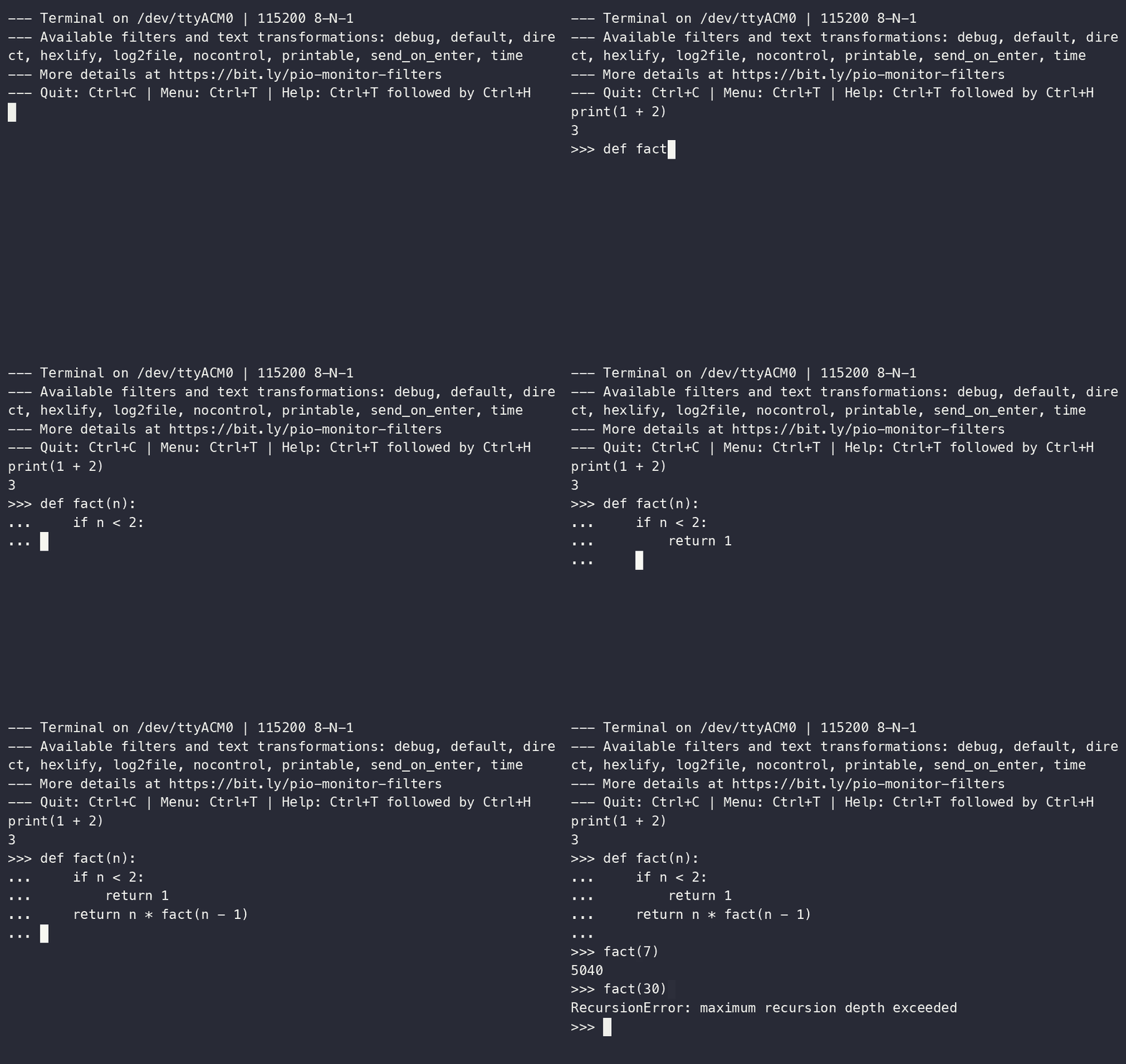
ボード上の REPL に関数を定義して呼ぶところ。fact(7) は 5040 を返し、
fact(30) は RecursionError で止まります#
print(1 + 2)
3
>>> def fact(n):
...     if n < 2:
...         return 1
...     return n * fact(n - 1)
...
>>> print(fact(7))
5040
>>> print(fact(30))
RecursionError: maximum recursion depth exceeded
0
>>> print(42)
42
>>>
実機ではこう光ります。
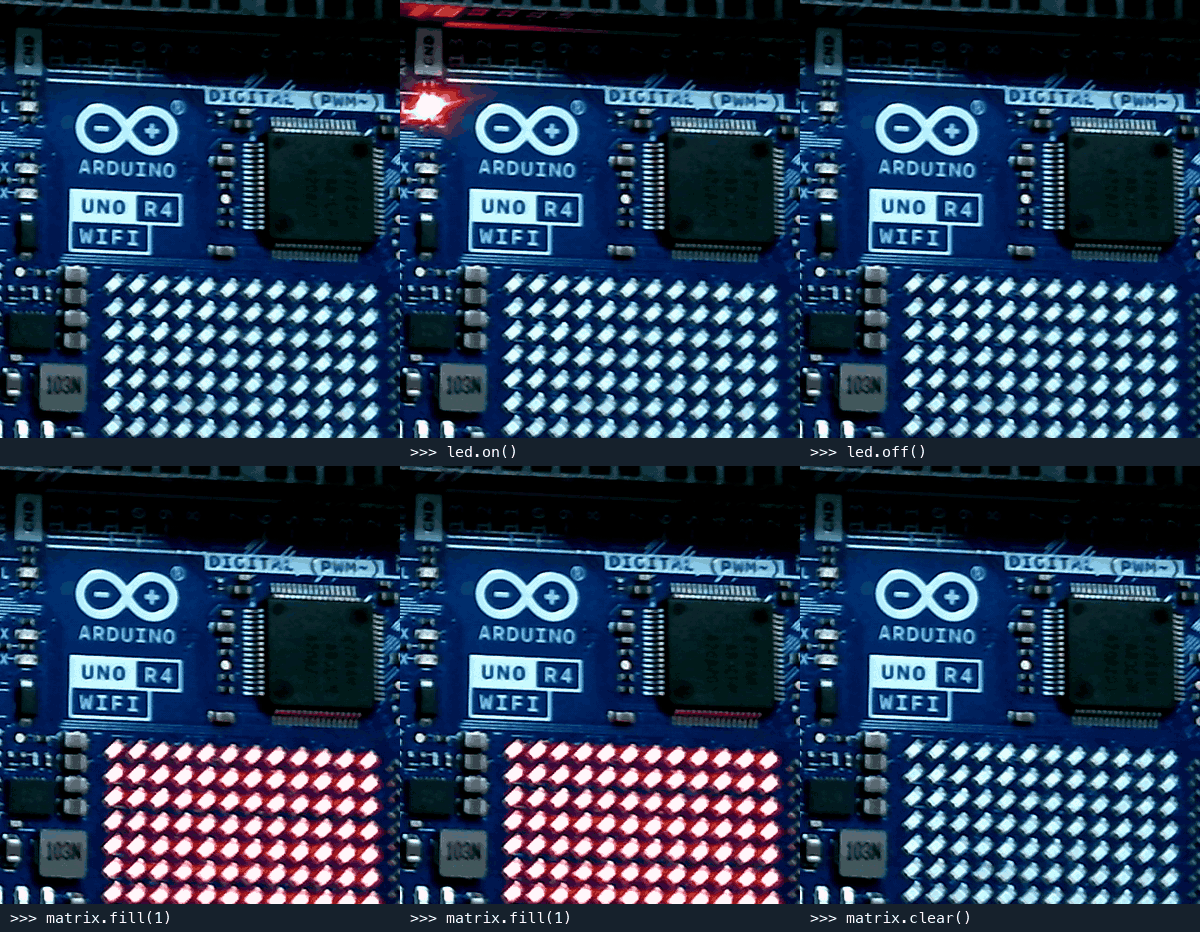
led.on() / led.off() で L LED が点いて消え、matrix.fill(1) でマトリクスの 96 個が全部点き、matrix.clear() で消えます。(UNO R4 WiFi を Web カメラで撮影)#
シミュレータで見る#
実機が無くても、同じファームウェアを シミュレータ で動かすとこう見えます。
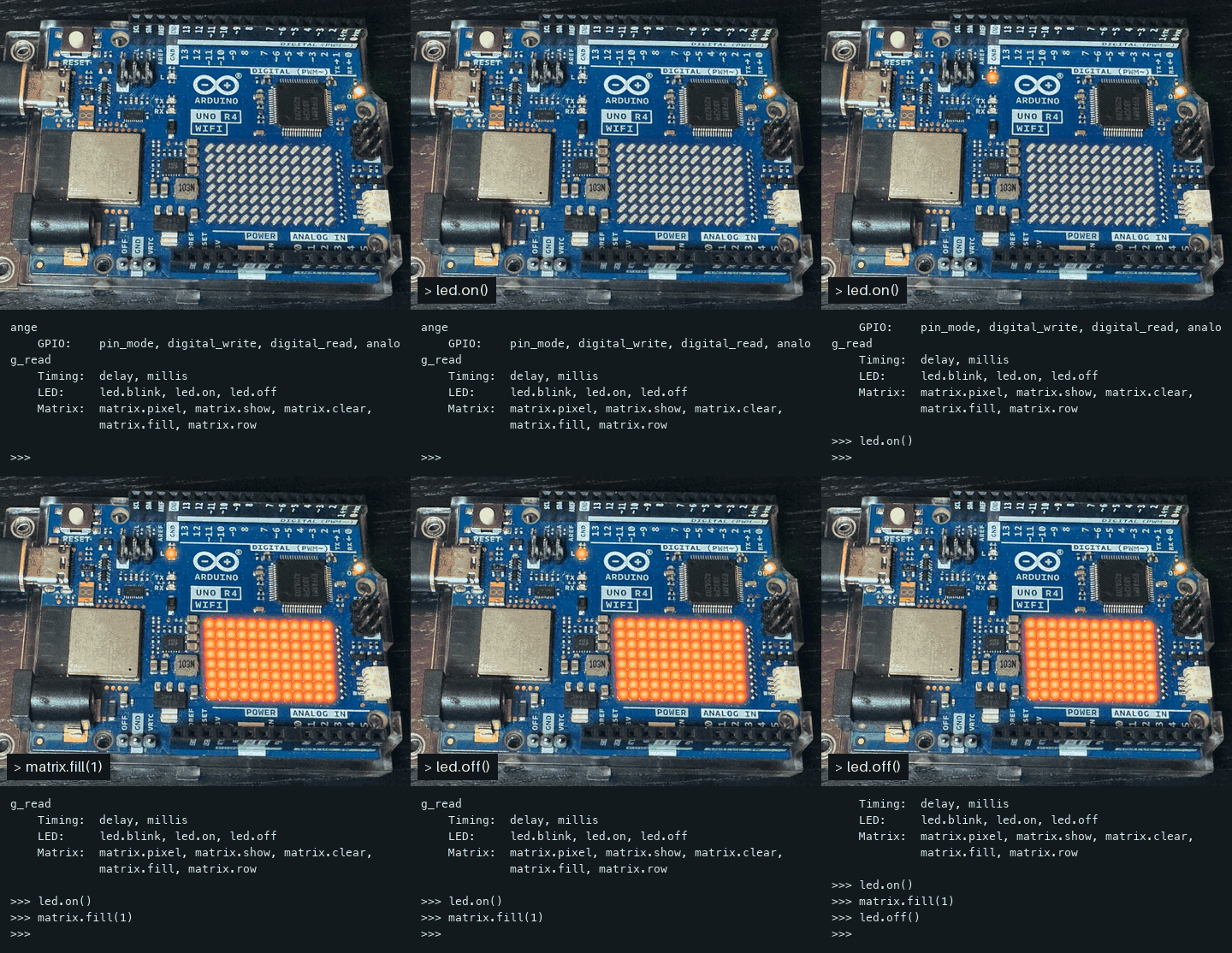
TinyPython の REPL で led.on() を打つと L が点き、matrix.fill(1) でマトリクスが全点灯、led.off() で L が消えます。(シミュレータで撮影)#
つまずきやすいポイント#
(読者からの質問に応じて随時追記します。質問は GitHub Issues へどうぞ)